STORIES
ABOUT
INDIANS.
CONCORD, N. H.
RUFUS MERRILL.
STORIES
ABOUT
INDIANS.
CONCORD, N.H.:
PUBLISHED BY MERRIAM & MERRILL
1854.
STORIES
ABOUT
INDIANS.
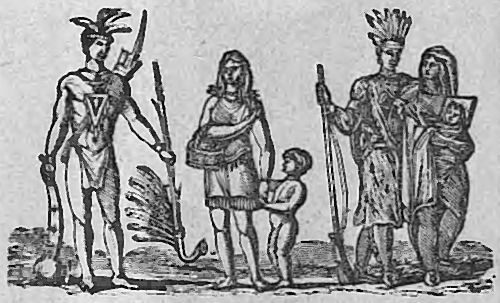
The Indians wereformerly lords ofthe soil we nowoccupy, and obtaineda subsistenceprincipallyby hunting andfishing.
They generallylived in villages,containing fromfifty to five hundred families. Theirhouses, called wigwams, were usuallyconstructed of poles, one endbeing driven into the ground, and[Pg 4]the other bent over so as to meetanother fastened in like manner;both being joined together at thetop, and covered with the bark oftrees. Small holes were left openfor windows, which were closed inbad weather with a piece of bark.They made their fire in the centreof the wigwam, leaving a small holefor a chimney in the top of the roof.
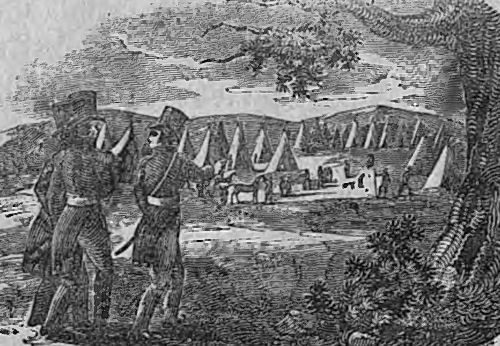
They had no chairs, but sat upon[Pg 5]skins, or mats, spread upon theground, which also served them forbeds. Their clothes were principallymade of the skins of animals,which in winter were sewed togetherwith the fur side turned inwards.
The Indians were very fond oftrinkets and ornaments, and oftendecorated their heads with feathers,while fine polished shells were suspendedfrom their ears.
A PAWNEE BRAVE.
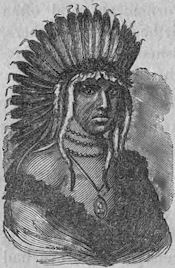
The following anecdote isrelated of a Pawneebrave, or warrior, (sonof Red Knife).
At the age of twenty-one, theheroic deeds of this brave hadacquired for him in his nationthe rank of the bravest of the braves.[Pg 6]The savage practice of torturingand burning to death their prisonersexisted in this nation. An unfortunatefemale of the Paduca nation,taken in war, was destined to thishorrid death.
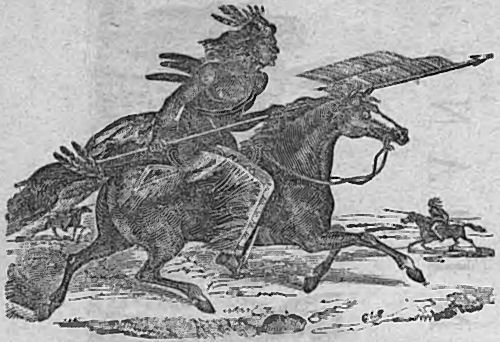
Just when the funeral pile wasto be kindled,this youngwarrior, havingunnoticedprepared twofleet horses,with the necessaryprovisions,sprangfrom his seat,liberated thevictim, seizedher in hisarms, placedher on one of the horses, mounted[Pg 7]the other himself, and made the utmostspeed toward the nation andfriends of the captive! The mul