WOMAN
VOLUME I
GREEK WOMEN
by
MITCHELL CARROLL, Ph.D.
Professor of Classical Philology in the George
Washington University
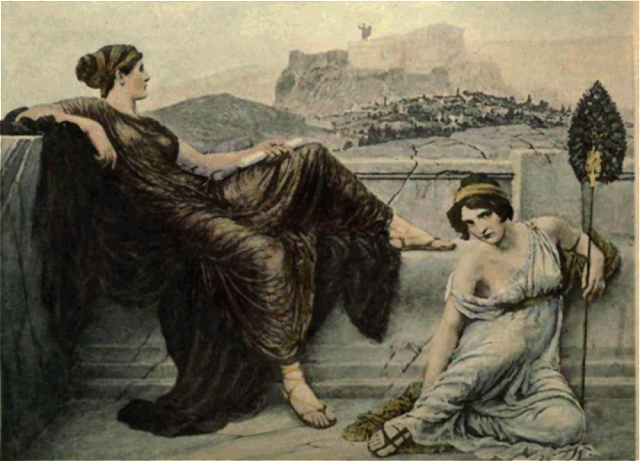
ASPASIA
After the painting by Henry Holiday.
Aspasia was born in Miletus. At an early age, accompanied
by another young girl, Thargelia, she went to Athens.
Their beauty and talents soon won them
distinction--Thargelia married a king of Thessaly, and Aspasia
married Pericles, "more than a king," says Plutarch.
The home of Aspasia in Athens was frequentrd by the élite
of the city and state, attracted by her beauty, her art
of speaking, and her influence. Socrates valued her great
mind, and even called himself one of her disciples. Plato
speaks of her great reputation. She was born in the fifth
century before Christ. The date of her death is not known.
WOMAN
In all ages and in all countries
VOLUME I
GREEK WOMEN
by
MITCHELL CARROLL, Ph.D.
Professor of Classical Philology in the GeorgeWashington University
Illustrated
PHILADELPHIA
GEORGE BARRIE & SONS, PUBLISHERS
GENERAL INTRODUCTION
The history of woman is the history of the world. Strait orthodoxy mayremind us that man preceded woman in the scheme of creation and thattherefore history does not begin with woman; but this is a speciousplea. The first historical information that we gain regarding Adam isconcerned with the creation of woman, and there is nothing to show usthat prior to that time Adam was more active in mind or even in bodythan a mollusc. It was not until the coming of woman that history beganto exist; and if the first recorded act of the woman was disastrous inits consequences, at least it possesses the distinction of makinghistory. So that it may well be said that all that we are we owe towoman. Whether or not the story of the Garden of Eden is to beimplicitly accepted, there can be no doubt that from the moment of thefirst appearance of mankind on the scene woman has been the ruling causeof all effect.
The record of woman is one of extremes. There is an average woman, butshe has not been found except in theory. The typical woman, as she isseen in the pages of history, is either very good or very bad. We findwomen saints and we find women demons; but we rarely find a mean. Hereinis a cardinal distinction between the sexes. The man of history israrely altogether good or evil; he has a distinct middle ground, inwhich we are most apt to find him in his truest aspect. There areexceptions, and many; but this may be taken as a rule. Even in theinstances of the best and noblest men of whom we have record this rulewill hold. Saint Peter was bold and cautious, brave and cowardly, lovingand a traitor; Saint Paul was boastful and meek, tender and severe;Saint John cognized beyond all others the power of love, and wished tocall down fire from heaven upon a village which refused to hear theGospel; and it is most probable that the true Peter and Paul and Johnlived between these extremes. Not so with the women of the same story.They were throughout consistent with themselves; they were utterly pureand holy, as Mary Magdalene,--to whose character great wrong has beendone in the past by careless commentary,--or utterly vile, as Herodias.Extrem