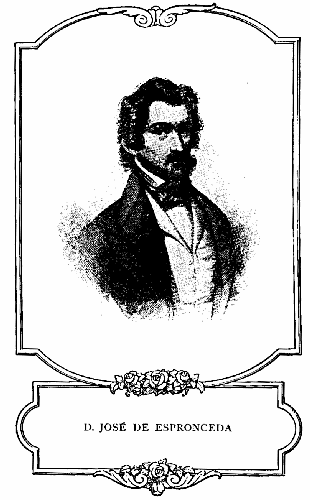
ESPRONCEDA
EL ESTUDIANTE
DE SALAMANCA
AND OTHER SELECTIONS
EDITED BY
GEORGE TYLER NORTHUP, PH.D.
PROFESSOR OF SPANISH LITERATURE
UNIVERSITY OF CHICAGO
PREFACE
The selections from Espronceda included in this volume havebeen edited for the benefit of advanced Spanish classes inschools and universities. The study of Espronceda, Spain'sgreatest Romantic poet, offers the best possible approach to thewhole subject of Romanticism. He is Spain's "representativeman" in that movement. Furthermore, the wealth of metershe uses is such that no other poet provides so good a text foran introduction to the study of Spanish versification. Theeditor has therefore treated the biography of Espronceda withsome degree of completeness, studying his career as one fullyrepresentative of the historical and literary movements of theperiod. A treatment of the main principles of Spanish versificationwas also considered indispensable. It is assumed thatthe text will be used only in classes where the students arethoroughly familiar with the rudiments of Spanish grammar.Therefore only the more difficult points of grammar are dealtwith in the notes, and little help, outside of the vocabulary, isgiven the student in the translating of difficult passages.
The editor makes no pretense to having established criticaltexts of the poems here printed, although he hopes that someimprovement will be noted over previous editions. A criticaledition of Espronceda's works has never been printed. Esproncedahimself gave little attention to their publication. Hartzenbuschand others intervened as editors in some of the earliesteditions. Their arbitrary changes have been repeated in allsubsequent editions. The text of "El Estudiante de Salamanca"has been based upon the "Poesías de D. José de Espronceda,"Madrid, 1840, the so-called editio princeps. This edition, however,cannot be regarded as wholly authoritative. It was notprepared for the press by the poet himself, but by his friendJosé García de Villalta. Though far more authentic in itsreadings than later editions, it abounds in inaccuracies. I havenot followed its capricious punctuation, and have studied itconstantly in connection with other editions, notably the editionof 1884 ("Obras Poéticas y Escritos en Prosa," Madrid, 1884).To provide a really critical text some future editor must collatethe 1840 text with that version of the poem which appeared inLa Alhambra, an obscure Granada review, for the year 1839."El Mendigo" and "El Canto del Cosaco" I also base uponthe 1840 edition, although the former first appeared in LaRevista Española, Sept. 6, 1834. I base the "Canción delPirata" upon the original version published in El Artista,Vol. I, 1835, p. 43. I take the "Soneto" from "El LiceoArtístico y Literario Español," 1838. For "A Teresa, Descansaen Paz," I follow the Madrid edition of 1884. The textof this, as for the whole of "El Diablo Mundo," is morereliable than that of the earlier poems.
I desire to thank Professors Rudolph Schevill, Karl Pietsch,and Milton A. Buchanan for helpful suggestions, and the lattermore particularly for the loan of rare books. The vocabularyis almost entirely the work of my wife Emily Cox Northup,whose collaboration is by no means restricted to this portionof the book. More than to any other one person I am indebtedto Mr. Steven T. Byington of the staff of Ginn andCompany, by whose acute and scholarly observations I haveoften profited.