Transcriber's Note:
The cover image was created by the transcriber and is placed in the public domain.
INDIAN PALMISTRY.
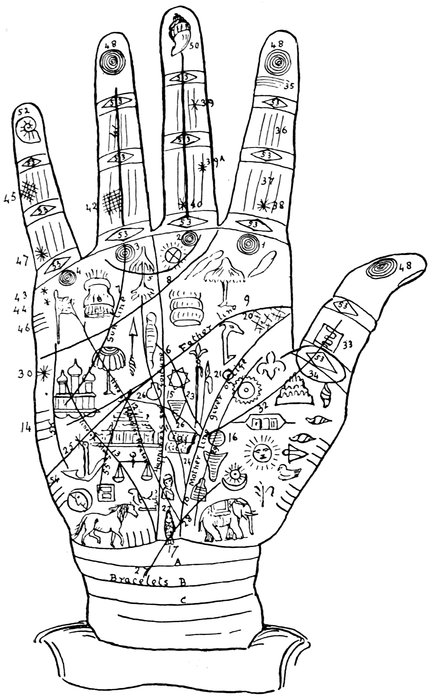
PLATE I.—THE REFERENCE HAND.
PREFACE.
Cheiromancy, the art of foretelling the eventsof life by the lineaments of the hand, derived itsname from the Greek word cheiros, the palm, andmanteia, to foretell, whence it has been vulgarlycalled Palmistry—as it is named in a recent Actof Parliament to forbid its practice for gain orreward. In Coleman's Mythology of the Hindoos,p. 202, it is written: "On the Buddha's foot is themark called the 'chakravarti,' wheel or discus,which should have been on the palm of the hand,by which the sages at his birth divined that hewould rise to considerable eminence." He says(p. 19): "Various data have been assigned to theperiod of Buddha's existence. The most correctseems to be about 550 B.C., whence, as the sagespractised cheiromancy at Buddha's birth, its existencemust have been much earlier known amongthe Indians." "In the year 1652," writes Zadkiel,"the celebrated astrologer, Geo. Wharton, Esq.,published a translation of 'a matchless piece' asvihe terms it, on the subject, written in Latin byDr. J. Rothman." Since that period the art ofcheiromancy has gradually fallen into disuse,chiefly from the extensive nonsense published byrecent writers. One of the writers makes ashallow attempt to disprove the connection whichexists between astrology and palmistry, whileanother says it is based on the principles of theKabalah, the latter being nothing more thana mnemonical system of astrology. From thewritings of Dr. J. Rothman and Geo. Wharton,Esq., I propose now to give, together with someof the choicest of those of the East, the principalmatter, and to explain in the ordinary languageused by palmisters such points as may requireelucidation. Mr. Wharton, a careful student inthese subjects, clearly proves that palmistry canonly act in accordance with astrology, and that theart of cheiromancy cannot be relied upon beyondthe period of from one to two years at most, for heobserves in his preface, "What more convincingthan if, by inspection made into the hand of anyman, I truly pronounce this or that planet essentiallydignified or angular in his geniture, or insuch or such a position with other planets or stars,another unfortunate, afflicted or defected? Or if,on the contrary, by looking first into the genitureand considering therein the several positions ofviithe planets and their configurations one to anotherand with other stars, I tell him, and that distinctlyand truly, the lines and signatures engraven uponhis head or hand—what, I say, is or can be moresatisfactory than this to rational men, as touchingthe power and influence of the planets and starsupon these i