Transcribed from the 1912 T. Fisher Unwin edition by David Price,
THE MABINOGION
TRANSLATED FROM THE RED BOOK OF HERGEST BY LADY CHARLOTTE GUEST
VOL. III. LONDON
T. FISHER UNWIN
11 PATERNOSTER
BUILDINGS MXCII
p. 7INTRODUCTION.
This third volume completes the series of Mabinogion and talestranslated by Lady Charlotte Guest.
As in the two preceding volumes, I have compared Lady Guest’s transcript with the original text in the Red Book of Hergest, and with Dr Gwenogvryn Evans’ scrupulously accurate diplomatic edition. I have, as before, revised thetranslation as carefully as I could. I have not altered Lady Guest’s version in the slightest degree; but I have again put in the form of foot-notes what seems to me to be a better or a more literal translation. The mistranslations are fairly few in number; but some of them are quite important, such as the references to pagan baptism or to the Irish Channel. At the end of my revision I may say that I have been struck by the comparative accuracy of the transcript of the Red Book which Lady Guest used, and by the accurate thoroughness with which she translated every one of the tales.
This volume contains the oldest of the Mabinogion—the p. 8four branches of the Mabinogion proper—and the kindred tale of Lludd and Llevelys. In all these we are in a perfectly pagan atmosphere, neither the introduction of Christianity nor the growth of chivalry having affected them to any extent.
The Story of Taliesin is the only one in the series that is not found in the Red Book of Hergest. It is taken from verymuch later manuscripts, and its Welsh is much more modern. Its subject, however, is akin to that of the Mabinogion proper; if, indeed, the contest between Elphin and the bards is an echo of the contest between decaying Paganism and growing Christianity.
OWEN EDWARDS.
Llanuwchllyn,
13th September 1902.
p. 11PWYLL PRINCE OF DYVED.
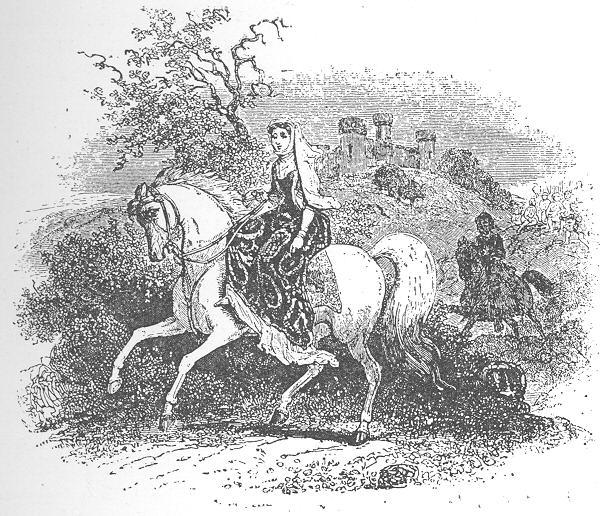
Pwyll, prince of Dyved, was lord of the seven Cantrevs of Dyved; and once upon a time he was at Narberth his chief palace, and he was minded to go and hunt, and the part of his dominions in which it pleased him to hunt was Glyn Cuch. So he set forth from Narberth that night, and went as far as Llwyn Diarwyd.[11a] And that night he tarried there,and early [11b] on the morrow he rose and came to Glynp. 12Cuch; when he let loose the dogs in the wood, and sounded the horn, and began the chace. And as he followed the dogs, he lost his companions; and whilst he listened to the hounds, he heard the cry of other hounds, a cry different from his own, and coming in the opposite direction.
And he beheld a glade in the wood forming a level plain, and as his